Monday, February 6, 2012

It's Okay to Eat your Chia Pet

There has been a lot in the news lately about "Chia Seeds".  They are actually the same seeds used in the "Chia Pets" figurines that first became popular in the 1980's.  Little did we ponder back then that the seeds were more than just part of a fun novelty item - they are actually very healthy to consume!

Chia seeds are a product of southern Mexico. They come from a desert plant called salvia hispanica.  The edible seeds contain a very high source of Omega-3 and also fiber, calcium, phosphorus, magnesium, manganese, copper, iron, molybdenum, niacin, and zinc.  Unlike flax seeds, they do not need to be ground up in order to be utilized by the human body.  You can add them to almost anything such as yogurt, oatmeal, baked goods, or smoothies to name a few.  They have a slight nutty taste but are still very easy to disguise in any recipe.  I added them to my smoothie recipe and it tasted delicious!  I served it to my husband this morning and he had no idea!


Recent research has focused on the connection between consuming chia seeds and blood sugar levels.  Because the seeds contain so much fiber it is believed that the gelling action of the seeds slows down the digestion of carbohydrates in the stomach, therefore keeping blood sugar levels more consistent. 

In regards to Omega-3, the seeds contain a type called α-linolenic acid (ALA) which is different from the types of Omega-3 found in salmon or other cold water fish.  ALA needs to be converted in the body to the kind of Omega-3 found in fish.  Omega-3 from fish has been connected with heart health.  Plant sources are still a healthy choice.  So have a Chia smoothie to wash down your grilled salmon.

Saturday, February 4, 2012

Saved by Imitation Miracle Whip

After work last Friday my husband said he felt shaky.  I asked if he ate lunch.  He said no. He forgot it somewhere.  He quickly found it on the kitchen counter-top where it had been sitting from 7AM until about 3PM.  I made him 2 turkey and American cheese sandwiches on bagel thins with Miracle Whip spread on one side of the bagel and Hellman's low-fat mayo on the other.  It was my attempt to slowly wean him off of Miracle Whip without him knowing.

As he was headed to an evening track meet he told me he would take the lunch and eat it at the meet.  I told him to throw it out.  We argued over potential food poisoning. I pointed out that bacteria can double every 20 minutes after food is left out for an extended time. He countered with "Our house was cold during the day since we left the heat off and his food would be fine".  He later called me from the meet and said he did not eat his lunch because it tasted weird.  I am not sure if it was an overgrowth of bacteria, it's common for food that has gone bad to not taste any different, or the Hellman's mayonnaise I snuck in. (I hate to say it but I was hoping he would eat the lunch because if he got food poisoning my thinking was that he would not eat food that was unrefrigerated again; of course I would not want him to get any life threatening illness - just a little stomach flu) Good news is that he agreed there was something wrong with the sandwiches and he threw them out after one bite. I think he will listen to me in the future.  Maybe (I'm delusional)

The "Temperature Danger Zone", 40°F to 140°F, is a range of temperatures where bacteria can multiple to unsafe levels. On Friday our house temperature was 65°F.  So bacteria was growing rapidly on my husbands lunch.  For more information on how to avoid food poisoning or to win an argument with your husband about it, check out this link. http://www.foodsafety.gov/keep/basics/index.html

This chart is from About.com.  I thought it was a nice explanation of the Temperature Danger Zone.
http://culinaryarts.about.com/od/safetysanitation/a/dangerzone_tab.htm

165°F and higher: Most bacteria die within several seconds
141°F to 164°F: Holding hot foods and sauces. Bacteria aren't killed, but they don't multiply, either.
40°F to 140°F:
Food Temperature Danger Zone
Bacteria thrive and multiply. Limit exposure of perishable foods to one hour or less.
33°F to 39°F: Refrigerated food storage. Bacteria aren't killed. They multiply, but relatively slowly. Food is safe here for a limited time.
32°F and lower: Frozen food storage: Bacteria aren't killed, but they don't multiply,

Avoid the Flak and Just Sneak in some Flax

I have regularly used smoothies as a way to get some fruit into my husbands diet.  He drinks them on the way to work.  I tried also sneaking in some leafy vegetables - but he did not want to drink something that was green.  I learned next time I will have to keep some kiwis and green grapes around and tell him the spinach I added was actually green fruit.

I have recently started sneaking in something more inconspicuous into his smoothies  - Ground Organic Golden Flax Seeds.  I bought this huge bag from Costco a while back and recently started using it.  I'm taking a guess here but I believe it was about $8.00 for a 3 lb bag.  The bag says it has 97 - 2 Tbsp servings.  So that is good for about 97 smoothies.  Since the seeds are already ground, this is an easy way to add some healthy fat, fiber and antioxidants to a smoothie without anyone knowing.  This product contains 2800 mg of Omega-3 fatty acids per 2 Tbsp. Flax seeds are a plant source of omega-3 which may aid in lowering total cholesterol and bad (LDL) cholesterol.  Flax seeds also contain lignans which are plant estrogens (antioxidants) that may help ward off some cancers.  Check out this article on Health Castle for more information. http://www.healthcastle.com/flax.shtml


Here is my Smoothie Recipe for 2 people
1 banana
6-7 large frozen strawberries
10 oz. canned unsweetened pineapple chunks (1/2 of 20 oz can)
1/4 cup fat free Greek yogurt
1 Tbsp agave nectar
2 Tbsp organic ground golden flax seeds
add water as needed and blend

Monday, November 14, 2011

Invasion of the Bread Snatchers


Okay, is this bad?  My husband really likes his Wonder White Bread, just the basic "Classic" bread.  In the past I have given him different brands of white bread with added fiber and he has told me he does not like them.  He has said they made his stomach hurt.  This could be attributed to an increase in fiber which normally should be added to your diet slowly to avoid this type of situation.  Anyways, I recently bought him 2 loaves of Wonder "Classic" white bread and I secretly bought an additional loaf of the Wonder "Smart" white.  For 2 days last week I switched the bread in his lunch and he did not notice.  I asked him if he liked his lunch and he said yes.  Now at home when he is making food for himself he uses the "Classic" white.  One of my co-workers suggested saving the bag of the "Classic" white and putting it on the "Smart" white.  I am going to try this next week as soon as he finishes the loaf of "Classic" white.  Although the packaging looks so similar I may be able to just eventually buy the "Smart" white and I don't think he would notice.

There are some key differences between these two types of bread.  The most noticeable is the price.  At my local grocery store the "Classic" white was $2.44 and the "Smart" white was $2.78.  A .34 cent difference.  In my opinion it is worth the extra money.  Looking deeper into the food label it is evident that the ingredients used to make the "Smart" white are superior.  The third ingredient in the "Classic" white is a sugar known as high fructose corn syrup.  The "Smart" white also has sugar however it is the fifth ingredient on the list.
Wonder "Smart"
Wonder "Classic"
Turning to the Nutrition Facts Panel you can also see some differences between the two.  The "Smart" has less calories, less fat, more fiber and also less carbohydrates which is something to note for people with diabetes who are counting carbs.  What is similar is the sodium between the two - about 100 mg per slice.

Wonder "Smart"
Wonder "Classic"

Wonder "Smart"
Wonder "Classic"
While whole grain bread is the best choice (because the manufacturing process for "whole grain" bread maintains the vitamins, minerals, and cancer fighting properties found in the whole grain), I look at "Smart" white as a stepping stone because it does have added fiber.  The average adult should consume about 25-35 grams of fiber per day.  Dietary fiber is indigestible. Fiber is necessary to move food through the intestine quickly so that we have limited exposure to any harmful substances that may be in food. Fiber also aids in helping the body to remove cholesterol therby lowering levels.  As a dietitian I always tell my clients that if you don't like something, don't eat it just because you think it is a healthy choice.  Food should be enjoyed.  If you eat that healthy option and weren't satisfied you will just end up eating what you wanted to in the first place and then you have consumed extra calories.


Tuesday, November 8, 2011

To Bone or Not To Bone?

Salmon with Bones
I've decided to go for another salad today and top it with canned salmon.  I usually use boneless salmon however I saw this canned salmon "with the bones" at Aldi's (discount grocery store) last month.  Since it was a good price at $1.19 for a 14.75 oz I decided to try it out to see if the taste was any different. 

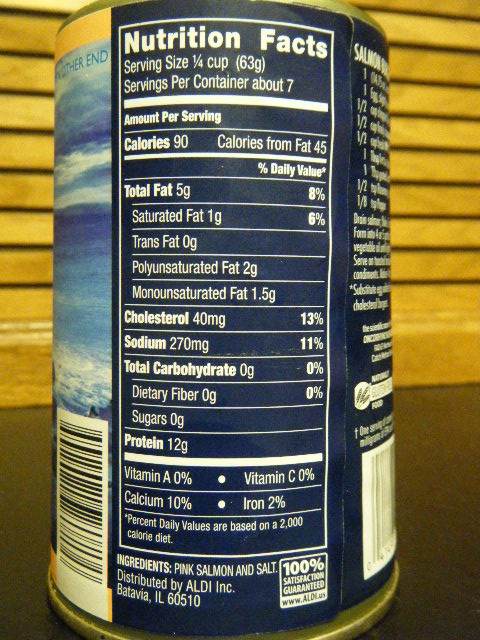
Northern Salmon Nutrition info
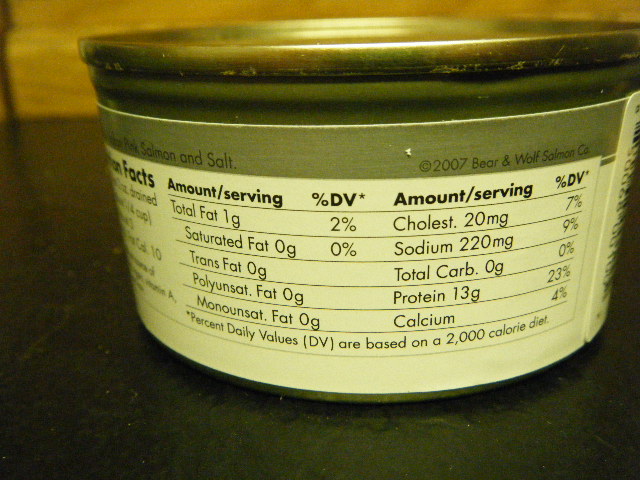
Similar to sardines, the benefit to eating fish with the bones is that it has significantly more calcium.  The brand I am using "Northern Catch" contains 100 mg of calcium per 1/4 cup.  Boneless salmon (purchased at Costco for $1.78 for a 6 oz can)  has 40 mg of calcium per 1/4 cup.  In addition, the one with the bones has a better taste because it is higher in fat (90 calories & 5 g fat versus 60 calories & 1 g fat per 1/4 cup for the boneless), however the smell is a little strong. 
 
This is where the problem comes in with my husband.  I used this salmon before in a salad and he said the smell was too strong to take to work.  I am sneaky it into his lunch today because I have two more cans that I need to use up.  Since it is such a moist salmon it taste much better on a salad than the boneless salmon.  I use boneless salmon on sandwiches because I can add some mayo to improve the taste.  Don't be afraid of the higher fat content in the salmon with the bones.  The fat in salmon in an essential fatty acid called Omega-3.  It's the type of fat our bodies need but can not make - so we have to get it from food.  The American Heart Association recommends adults to consume about two 3.5 oz servings of fatty fish per week.  Check out this link for more info AHA Fish Info

Boneless Salmon from Costco. $1.78 / 6oz
Nutrition Info for Costco salmon

Monday, November 7, 2011

Converting the Spinach Hater

My husband usually likes sandwiches for lunch because they are easy to eat between teaching classes.  In addition, I usually give him another sandwich to eat on the go after school when he is coaching track or cross country.  However the season just ended so I thought I would give him a salad today since he will have a little more time.  I have had success with this salad in the past.  My husband always hated spinach but this salad he loves.  I think it is because I use the organic "Earthbound Farms" spinach.  Today I am using the "Spring Mix / Spinach Blend".  I bought a 1 lb tub for about $4.00 at Marc's (a local discount grocery store).  This tub is usually good for 1 week.  I can generally get about 2 salads a day out of it.  The cost is about 40 cents for the lettuce portion of the salad. 

Here is what I put in his salad and mine.

2 cups of spring mix lettuce & spinach mix
1 cup of shrimp (bought pre-cooked; defrost)
2 T of feta cheese
6 cheerub tomatoes
1/3 cup of Mandarin oranges (in light syrup)
3 T of Hidden Valley Ranch Dressing (this is just for my husband - I don't use salad dressing)

Without dressing the salad is about 240 calories, 6g fat, 3g saturated fat & 25g protein.
3 T Ranch adds 120 calories, 12g fat, 1.5 g saturated fat & 1.5g protein.

I also gave my husband a Nutri-Grain Apple Cereal Bar.  He told me he doesn't really like them because he feels like they are wasted calories (120 cal per bar).  He says they don't fill him up.  However I still put one in his lunch.  I figured it might keep him away from the school cafeteria or vending machines.  Each bar also contains 8 grams of whole grains.  The recommended servings of whole grains per day is 48 grams.  I have heard if you keep offering children a new food item they will eventually eat it - I am trying this same approach with my husband.   I got 16 bars for $2.50 at Marc's.  You can't beat the price.  I bought more than one box.  So we will be eating them until they are gone!